
Original research
Input: a protocol, de-identified data and measurement procedures.
Work: analysis planning, tables and figures, Methods and Results.
Check: STROBE for observational studies; CONSORT for randomized trials.
Work with your own data and sources: define the question, check the methods, build tables and prepare a manuscript in one project. For clinicians, postgraduate researchers and scientific teams.
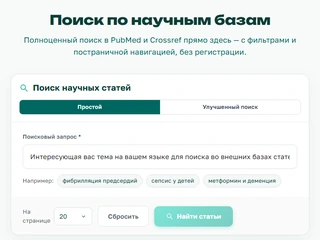
Search PubMed and Crossref without signing up
Teaching example: describing the relationship between shift work and sleep in adults. This is a workflow for an observational article, not the result of a completed study. Numerical results and conclusions require analysis of your own data.
Record the population, working conditions, sleep measurements, time period and potential confounders in the project research profile.
Output: a research question and analysis plan.
Start with the query shift work sleep adults, check study designs and methods, and save relevant sources.
Output: a verifiable bibliography and rationale for the question.
State recruitment, eligibility criteria, measurements and limitations. For an observational study, use STROBE to check the completeness of reporting.
Output: a Methods section with gaps identified.
Upload a de-identified table and check coding and missing values. Choose an analysis that fits the design, variable types and assumptions.
Output: tables, figures and results calculated from your own data.
Link conclusions to analyses and sources, state limitations, check the journal requirements and export the document for co-authors.
Output: an editable manuscript and a list of next revisions.
The article type determines the materials, analysis and reporting requirements. A guideline helps describe the work completely; it does not, by itself, make the research high quality.
Input: a protocol, de-identified data and measurement procedures.
Work: analysis planning, tables and figures, Methods and Results.
Check: STROBE for observational studies; CONSORT for randomized trials.
Input: a question, scope and selected sources.
Work: comparison of findings, a thematic outline, citations and limitations.
Check: describe search and selection methods explicitly; a review does not become systematic just because of its title.
Input: a protocol, search strategy and eligibility criteria.
Work: screening, data extraction, risk-of-bias assessment and synthesis.
Check: PRISMA 2020 for reporting; meta-analysis requires a justified basis for combining studies.
Input: a de-identified timeline, observations and necessary consent.
Work: case structure, discussion in context and conclusions.
Check: CARE and journal requirements; a single case does not establish treatment effectiveness.
An article structure, editable text, version history and co-author revisions.
Selected literature in your project, in-text citations and a formatted reference list.
Analyses of your data, charts and insertion of results into the document.
Quality explanations, reporting gaps and checks against selected requirements.
Open manuscript review →Save and export the document for further work. Acceptance and review timelines are determined by the selected journal.
Research often requires several separate tools. We connect the steps in one workflow.
The diagrams below illustrate platform functions, not study results. Check conclusions against your own materials.
Search PubMed, Crossref and other available databases to collect relevant literature. Select articles, save them to your project and translate available titles and abstracts when needed. Full-text access depends on the publisher.
The platform helps extract designs, sample characteristics and outcomes, compare findings and identify disagreements. Verify extracted details against the original, especially when only an abstract is available.
Choose an instrument for the design: for example, RoB 2 for a randomized trial or AMSTAR-2 for a systematic review. The platform suggests an assessment with explanations based on the available text; the author checks it against the original. Reporting checks and risk-of-bias assessment serve different purposes.
Import data, specify groups and outcomes, and check missing values and assumptions. The platform helps choose and run analyses, build tables and figures. The author confirms the design and interpretation; discuss complex analyses with a statistician.
A collaborative editor with formatted citations and a reference list. Choose the supported style that fits the journal, then export to Word or PDF and check the final document.
Article search, clinical calculators and Russian Ministry of Health guidelines are available on the website.
Search PubMed and Crossref with year filters to find papers and read abstracts.
Open search →Medical calculators for decision support: risk scales, indices and formula-based calculations.
Open calculators →Russian Ministry of Health guidelines: search by title, disease or ICD-10 code, with specialty and age filters. Source documents remain in Russian.
Open directory →Keep sources, an outline and manuscript versions in one project. Discuss methods and revisions with your supervisor and record decisions as the work progresses.
Return to research between clinical tasks. Sources, data, analyses and writing stay in one workspace.
For universities, research institutes and publishers: collaboration, participant roles and separate budgets. Access and data-processing conditions are described in the platform documentation.
Institutional terms →The project stores documents, sources, versions and work history so you can continue later. Access depends on roles and invitations. De-identify clinical materials before upload; data-processing and AI-use rules are described in the privacy policy.
Participants can access materials within their permissions. Check the team membership before collaborating. Privacy policy →
Registration is free. Public search, calculators and guidelines are available on the website. Paid operations use your account balance or an available institutional budget.
For batch review, translation or generation, request an estimate for the selected materials. The estimate shows roubles, the work breakdown and available balance.
Confirm the work or use the automatic charging mode you selected. Check completed operations and charges in your spending history.
Manual editing and paid assistance are different actions. Free allowances and prices follow the current price list; the total depends on your workflow.
Example workflow: assess selected sources → prepare a review draft → review the manuscript. Each step needs an estimate based on its actual scope. This description was checked against the cost-estimation mechanism on 14 October 2026; no fixed amount is quoted without your materials.
From a research question to manuscript submission. Guide currently available in Russian.
Read the guide →Information needed to assess and reproduce a study. Guide currently available in Russian.
Review your Methods section →Choose reporting guidance for your study design. Guide currently available in Russian.
Choose a guideline →